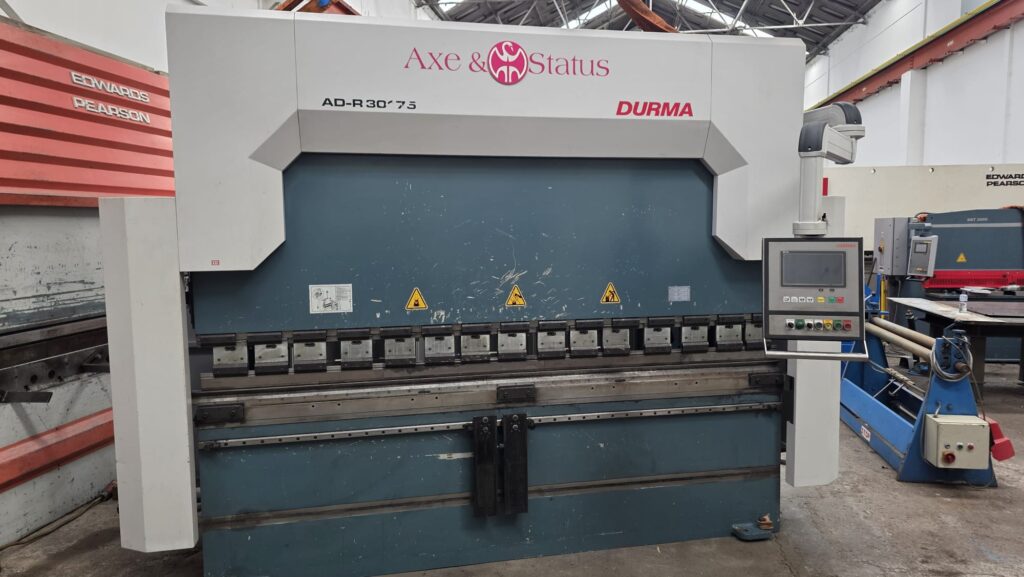
A press brake is the machine a fabrication shop lives or dies by. Get the right one and it quietly earns its keep for twenty years. Get the wrong one and it fights your operators every single day, drifts on angles, and costs you in scrap and setup time you never fully see on a spreadsheet.
The trouble is that a used press brake can look identical to another one twice its value. Same colour, same bed length, same tonnage on the plate. The differences that matter are the ones you cannot see from the doorway.
This is the guide we wish every buyer had before they rang us. Whether you buy from us or from someone else, know what you are looking at.
Start with the job, not the machine
Before you look at a single used press brake for sale, be clear on what you are actually bending. The machine follows the work, not the other way round.
Ask yourself:
- What is the thickest and longest part you bend regularly?
- What material, and how hard is it? Stainless needs far more tonnage than mild steel for the same bend.
- What is the tightest inside radius you need?
- How complex are the parts? Simple single bends, or multi-hit boxes and returns?
Those answers decide the tonnage, the bed length, the backgauge and the control you need. Buy on a vague idea of “something about 100 tonne” and you will either overpay for capacity you never use or, worse, buy short and turn work away.
Tonnage and bed length: the starting point, not the finish
These are the two headline numbers, and they matter, but they are only the entrance to the conversation.
Tonnage is the force the machine can apply. Air bending needs far less than bottoming or coining, and thicker or harder material needs more. There are standard charts for this, and a decent dealer will work it out with you rather than leaving you to guess. The rule of thumb is to have some headroom, but not to pay for a 200 tonne machine to do 60 tonne work.
Bed length needs to suit your longest part with room to spare, because bending near the very end of the bed is hard on the machine and on your accuracy. If your longest part is 2 metres, you do not want a 2 metre bed.
Get these two right and you have a machine that can physically do the job. Everything below decides whether you will actually be happy with it.
Ram repeatability: the number nobody asks about
This is the single most important thing on a press brake, and it is the one buyers most often forget to check.
Repeatability is how accurately the ram returns to the same position on every stroke. If it wanders, your bend angle wanders with it, and your operator spends the day tweaking and re-bending instead of producing. On a CNC machine this should be measured in microns. Ask what it is, and ask when it was last verified.
A machine with poor repeatability is not a bargain at any price. It is a daily tax on everything you make.
Backgauge: how many axes do you need?
The backgauge positions the part for each bend, and the number of axes it has decides how complex a job the machine can handle without a fight.
- X axis only moves in and out. Fine for simple, flat, single-bend work.
- X and R adds height adjustment, so the gauge can follow the part up. This is where most real fabrication work needs to be.
- More axes (X, R, Z1, Z2 and beyond) let the fingers move independently for stepped and tapered parts.
If you bend anything with returns, flanges or varying heights, an X-only machine will hold you back. Match the backgauge to the parts you actually make.
Crowning: the thing that catches people out on long beds
When a press brake bends a long part, the bed and ram flex very slightly in the middle under load. Without compensation, that gives you a tighter angle at the ends than in the centre of a long bend.
Crowning counters that flex so the angle is consistent across the whole length. Some machines have automatic CNC crowning, some are manual, and some older machines have none at all and rely on the operator shimming the tooling by hand. On long work, crowning is not a luxury, it is the difference between a part that passes and a part that goes in the bin.
The control: where used machines quietly die
You can buy a mechanically perfect press brake and still end up with a paperweight, and the culprit is almost always the control.
A control from a manufacturer who no longer supports it, or a proprietary system with no spare parts left in the world, turns a good machine into scrap the day a board fails. Before you buy, find out:
- What make and generation of control is it?
- Is it still supported, and are parts still available?
- Can anyone still service it if it goes down?
- Does it do what you need, 2D or 3D programming, offline programming, angle measurement?
A well-supported modern control on a slightly older machine is a far safer buy than a dead control on a newer one.
Tooling: rarely included, never free
Ask exactly what tooling comes with the machine, what style it is, and whether it fits anything you already own. The tooling style, whether American, European, or a proprietary system, determines what you can use and what you will have to buy.
A machine sold “bare” can cost you several thousand pounds in tooling before it makes a single part. That cost is real and it belongs in your comparison, so get it on the table before you agree a price, not after.
Safety: your responsibility, whatever it came with
Under PUWER, the duty to make sure a press brake is safe and suitable for use falls on you as the employer, regardless of what the machine had when you bought it.
Press brakes are among the higher-risk machines in any workshop, so that means proper guarding, light curtains or a laser guarding system, working stop controls, and safe access. A reputable seller will raise this with you rather than hope you do not think about it. If a machine needs its guarding bringing up to current standard, far better to know before it lands on your floor than after an HSE inspector points it out.
Buying used vs new
A good used press brake is one of the smartest buys in fabrication. You get a serious, capable machine for a fraction of new money, and a well-maintained older machine with a supported control will outlast plenty of cheaper new imports.
The key is buying from someone who knows the machine, has checked it over, and will tell you the truth about it. That is where a dealer earns the difference over an auction lot bought blind. A machine that has been inspected, that comes with honest answers and some back-up if something is not right, is worth paying a bit more for.
Where to find used press brakes for sale in the UK
If you are in the market, have a look at the current stock of used press brakes for sale at Senior Machinery. We have been buying and selling metalworking machinery for over 20 years, and we would far rather sell you the right machine for your work than the most expensive one on the floor.
Not sure what suits the job? That is exactly the conversation worth having before you spend the money.
Call Matt Senior on 07971 871254 Email matt@seniormachinery.co.uk
Tell us what you are bending, how long, how thick and in what material, and we will point you at the right press brake, whether it is one of ours or not.
Browse the current range of press brakes here.