Bending rolls are one of those machines where the specification sheet tells you surprisingly little about whether it will do your work. Two machines quoting the same width and the same plate thickness can behave completely differently on the shop floor, and the difference usually comes down to roll configuration, roll diameter and how the machine handles pre-bending.
This is a practical guide to choosing bending rolls, written from the perspective of what we see coming in and going out of the yard.
What Bending Rolls Actually Do
Bending rolls, also called plate rolls or plate bending rolls, form flat plate or sheet into a curve, a cylinder or a cone by passing it between driven rolls while an adjusting roll applies bending force.
Straightforward in principle. The complications are all at the ends of the plate.
When plate enters a set of rolls, the leading edge is not gripped by the bending geometry until it has travelled some distance in. The result is a flat spot at each end of the plate: a length that stays straight while everything between the flats curves properly. On a cylinder that has to be welded and pressure tested, or on anything where the joint has to close cleanly, those flats are the whole problem.
Everything that distinguishes a good set of rolls from a cheap one is about dealing with those flats and holding the plate under control while you do it.
Three Roll or Four Roll: The Decision That Matters Most
This is the question worth thinking hardest about, and the answer depends on your work mix rather than on which is objectively better.
Three-roll double pinch
On a three-roll double pinch machine, the two lower rolls act as pinching and bending rolls and can each be raised independently. Because both sides can pinch, you can pre-bend the leading edge, roll the body, and then pre-bend the trailing edge without taking the plate out and turning it round.
Morgan Rushworth’s DPBH-3 range is a good example of the type: pyramid style in a double pinch design with all three rolls hydraulically driven, hydraulic drop end for removing a finished cylinder, and digital read-outs showing pre-bending roll position.
Strengths: simpler, generally less expensive for a given capacity, well proven, and entirely capable of good cylinders in competent hands.
Limitations: the plate is not continuously held, so it needs more operator attention on positioning. Multiple radius work and tight tolerance repeat work is harder.
Four roll
A four-roll machine adds a fourth roll below the top roll, whose job is to pinch and hold the plate. Three rolls drive, the fourth clamps.
On the Morgan Rushworth DPBH-4 range, three of the rolls are hydraulically driven and the fourth lower roll is hydraulically adjusted up and down to pinch the material into position. The consequence is that the workpiece is always held, which is exactly what you want during multiple radius bending, and it makes a substantial difference to how repeatable the job is.
Strengths: the plate is clamped from the moment it enters until the moment it leaves. Squaring up is quicker, pre-bending both ends is straightforward, multiple radius and elliptical work becomes practical, and it is far less dependent on operator skill. Cycle times are usually shorter.
Limitations: more expensive for equivalent capacity, and more hydraulics and controls to maintain.
Which one
If you roll straightforward cylinders in reasonable batch sizes and you have a skilled operator, three-roll is often the sensible commercial answer.
If you do varied work, multiple radii, tight tolerance work, pressure vessel work, or you have operators of mixed experience, the four-roll pays for itself in scrap avoided and time saved. It is also considerably easier to hand over to a new operator, which matters more than most buyers allow for.
Reading Capacity Figures Properly
This is where buyers get caught.
Thickness ratings assume mild steel at full width. A machine rated at 16mm is rated on ordinary mild steel across its full bending length. Put higher yield material through it, or a grade with more spring in it, and the effective capacity drops. Stainless and higher tensile grades derate significantly.
Pre-bending capacity is lower than rolling capacity, always. Pre-bending the edge takes more force than rolling the body, so manufacturers quote both. The pre-bend figure is the one that governs whether you can actually produce a clean cylinder in that thickness. Across the DPBH-4 range, for instance, the published figures run up to 70mm pre-bending against up to 85mm rolling.
Check capacity against the diameter you need. Rolling a small diameter in thick plate is a different demand from rolling a large diameter in the same plate. Small diameter, thick plate is the hardest thing you can ask of a set of rolls.
Roll diameter matters more than the brochure suggests. Larger rolls resist deflection, which means a more consistent radius across the width and better performance at the top of the thickness range. Two machines with the same width and thickness rating but different roll diameters are not the same machine. The DPBH-4 range spans 280mm up to 680mm roll diameters for exactly this reason.
Minimum rolling diameter. Usually expressed as a multiple of roll diameter. If you have a job with a specific tight radius, check this figure before anything else.
Features Worth Paying For
Hydraulic drop end. Lifts or drops the end bearing housing so a completed cylinder can be lifted off the top roll. Without it, closed cylinders come off with difficulty or not at all. On any machine intended for cylinder work this is essential, not optional.
Top roll tilt. Allows the top roll to be angled for cone bending. If you have any cone work, you need it.
Cone bending device. A dedicated attachment for cone rolling. Worth having if cones are part of your regular mix.
Digital read-outs on the adjusting rolls. DRO on the bending rolls turns a skilled operation into a repeatable one. First-off setup gets faster and repeat jobs get considerably faster. On a four-roll machine, look for DRO on all three adjusting rolls.
Induction hardened rolls. Surface hardening resists marking and wear. It matters more if you handle stainless or finished surfaces.
Mobile control panel. Lets the operator stand where they can actually see the work rather than at a fixed post.
Safety trip wire. A trip wire around the machine is standard on current Morgan Rushworth machines. On any used machine, check what guarding is fitted and what condition it is in, because this is a machine that will pull an operator in without hesitating.
Buying Used Bending Rolls: What to Check
Bending rolls are among the better used buys in fabrication. They are simple in concept, heavily built, and a well maintained machine will work for decades. But there are specific things to look at.
The rolls themselves. Sight along them. Look for scoring, pitting, flats and any sign of bending. Roll condition transfers directly onto your work, and re-machining or replacing rolls is expensive enough to change the economics of the purchase entirely.
Roll deflection under load. If you can, watch it roll something near the top of its range across the full width. A machine that has been consistently overloaded will show it as a thickness variation in the finished radius.
Bearings and end housings. Listen and feel for play. The drop end housing takes a lot of abuse.
Hydraulics. Check for weeping cylinders and hoses, and watch the pressure hold. Ask when the oil was last changed and whether the filters have been serviced.
Drive and gearbox. Listen through the range. Look for oil leaks at the reduction unit.
Electrics and controls. Older machines frequently have obsolete drives and controls. Ask specifically whether replacement parts are still available, because a machine that cannot be repaired is a machine you cannot use.
The DRO. Confirm the read-outs actually work and read accurately. Retrofitting is possible but not free.
Guarding and compliance. Establish what safety equipment is fitted and whether it functions. Anything you put into production has to be safe and compliant, and that is your responsibility as the operator.
Foundations, power and access. Weight, floor loading, three-phase supply and how you are going to get it into the building. Ask before you buy, not after it arrives on a low loader.
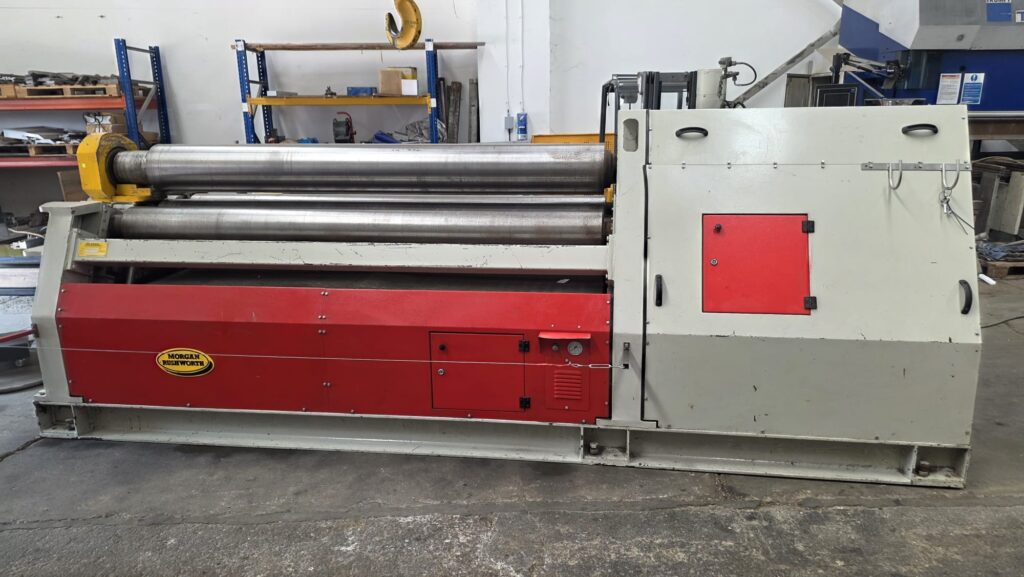
Featured Machine: Morgan Rushworth DPBH-4 2550mm x 16mm
We currently have a Morgan Rushworth DPBH-4 2550mm x 16mm in stock.
This is a hydraulic four-roll plate bending machine with a 2550mm bending width and 16mm capacity. As covered above, the four-roll configuration means three driven rolls plus a hydraulically adjusted lower pinching roll, so the plate is held from entry to exit. Squaring is quicker, both ends can be pre-bent without turning the plate, and multiple radius work is genuinely practical rather than a fight.
It is a sensible size of machine for a lot of general fabrication: wide enough for real tank and vessel work, thick enough for structural and heavier plate, and not so large that it dominates a bay or needs exceptional foundations.
Morgan Rushworth is a well established name in UK fabrication machinery, which matters on the used market for the reason that always matters: parts, support and documentation are available.
View the full listing and specification →
All Bending Rolls In Stock
Our bending rolls stock changes regularly, covering plate bending rolls and section bending rolls across a range of widths and capacities.
View all bending rolls in stock →
If you cannot see what you need, tell us what you are trying to roll — material, thickness, width, diameter and grade — and we will tell you straight what machine you actually need. Frequently it is not the one people ring up asking for.
We buy as well as sell, so if you have a machine surplus to requirements we are interested in that too.
Talk to Us
Senior Machinery Ltd
📞 07971 871254 ✉️ matt@seniormachinery.co.uk
Call Matt to discuss what you are rolling. Bring the material grade, thickness, width and the diameter you need, and the conversation gets a lot shorter.