Buying a used press brake is not like buying a van. You cannot take it for a test drive round the block, you cannot easily give it back, and once it is bolted to your floor and wired into your supply, you own the problem.
Most people in fabrication have a story about a machine that turned up and was not what they thought they were getting. Backgauge that would not repeat. A guillotine that needed a full blade regrind before it cut anything straight. A control nobody could get parts for.
None of that is bad luck. It is what happens when nobody asked the right questions, and nobody was volunteering the answers.
After more than twenty years of buying and selling metalworking machinery, here is what we think a machine tool dealer should be putting in front of you before you commit, and what you should be asking if they are not.
Press brakes: it is not just tonnage and bed length
Everyone leads with tonnage and bed length, because those are the two numbers that decide whether the machine can do the job at all. They are the start of the conversation, not the end.
What actually decides whether you are happy with it in twelve months:
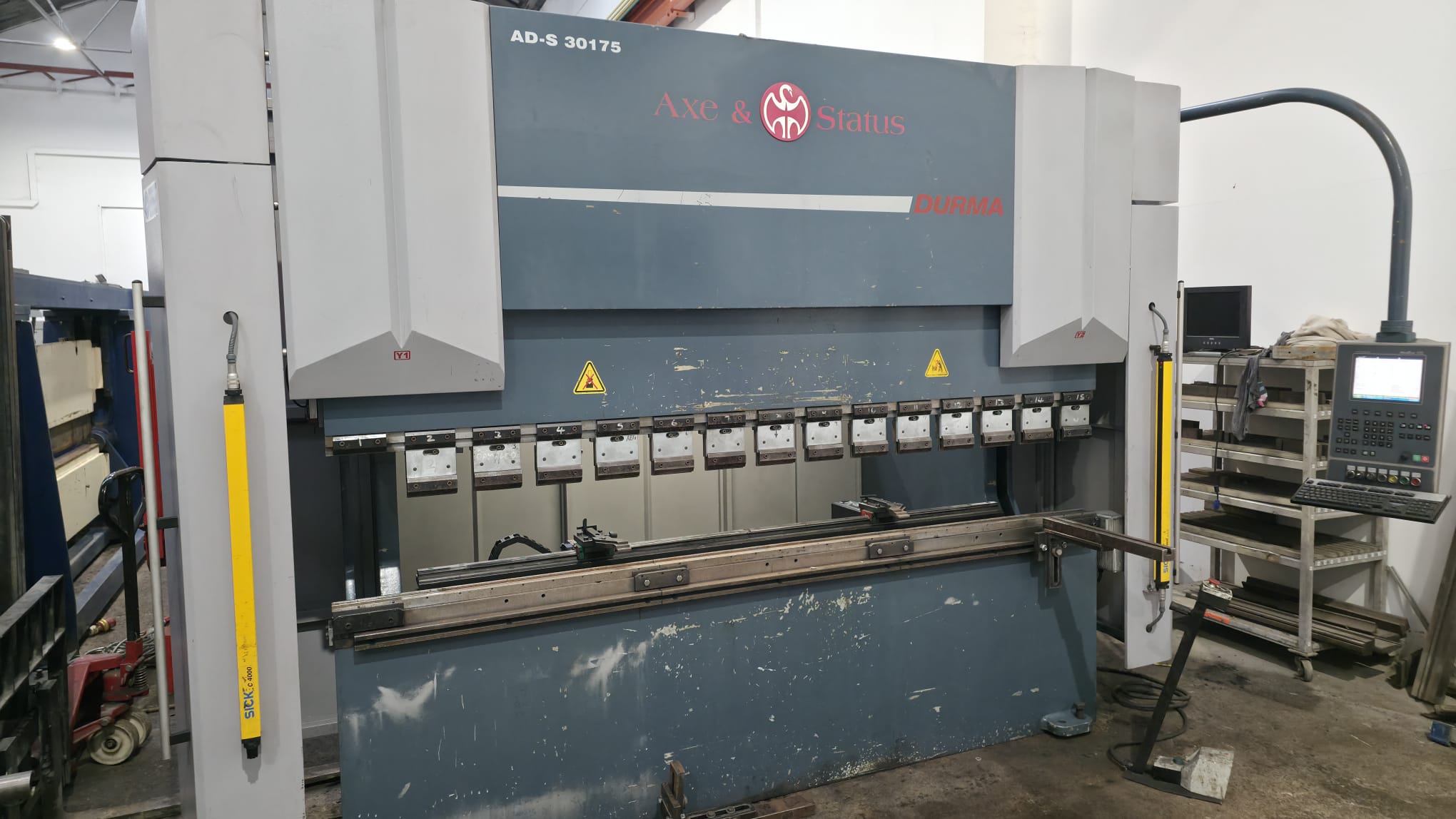
Ram repeatability. This is the whole ball game on a press brake. If the ram does not come down to the same place every time, your angles wander and your operator spends the day chasing them. Ask what the repeatability is and whether it has been checked recently.
Backgauge axes. An X and R gauge is a different machine from an X-only. If you are doing anything with returns, flanges and multi-hit parts, the extra axes are the difference between a machine that flows and one that fights you.
Crowning. Without it, a long bed gives you a different angle in the middle than at the ends on longer parts. Manual shimming works but it costs you time on every setup. Find out what the machine has.
The control. This is where used machines go to die. A control from a manufacturer who no longer supports it, or a proprietary system with no spares, turns a good machine into scrap the day a board fails. Ask what the control is and whether parts and support are still available.
Tooling. Ask exactly what tooling comes with it, what style it is, and whether it will fit anything you already own. Tooling is not a rounding error, and a machine sold “bare” can cost you thousands more before it makes a part.
Have a look at what we currently have in press brakes if you want a feel for what is about.
Guillotine shears: the blade tells you most of it
On a guillotine, the headline capacity is the thickness in mild steel. Note the words “mild steel”. If you are cutting stainless, the same machine will do noticeably less, and if nobody mentions that, they are letting you find out on your own.
Things worth knowing before the money moves:
Blade condition and how many regrinds are left. Blades can be reground, but only so many times before the blade is undersized and needs replacing. A tired blade shows up as burr, roll-over on the edge and a cut that is not square through the thickness. Ask when it was last ground.
Blade gap adjustment. Cutting 2mm and 10mm want different clearances. If the machine has manual gap adjustment, someone has to actually do it, and a lot of shops never bother, which chews blades. Powered gap adjustment saves you from your own workforce.
Rake angle. More rake means less tonnage needed but more twist in narrow strips. Fixed rake is fine for most work. Variable rake matters if you are cutting a wide range.
Backgauge and squaring. Check the backgauge repeats and that the squaring arm and front supports are actually there and straight. They go missing.
Hold-downs. Look at the feet. Worn or seized hold-downs mean the sheet lifts and your cut wanders.
Plate and section bending rolls: three roll or four?
This is the question that catches people out, and it is worth understanding before you look at prices on bending rolls.
A three roll initial pinch machine is the cheapest way in, but you cannot pre-bend both ends of the plate. You end up with a flat at the trailing edge that has to be dealt with afterwards, which on a rolled cylinder means extra work every single time.
A four roll machine pre-bends both ends, holds the plate properly through the whole pass, and generally gets you a rounder job with less handling. It costs more. On production work it usually pays for itself.
Beyond that, check:
- Roll diameter and material. Undersized rolls deflect on heavy plate and you get a barrel shape instead of a cylinder.
- Section rolling. If you want to roll angle, box or tube as well as plate, the machine needs the tooling and the drive to do it. Not every plate roll will.
- Cone bending. If you need cones, say so up front. Not all machines are set up for it.
- Roll condition. Scoring, pitting or a worn crown on the rolls transfers straight onto your work.
And the rest of the shop
We buy and sell all types of plate and section bending rolls, guillotine shears, press brakes, saws, CNC lasers, CNC punches, steelworkers, lathes, millers and grinders, plus a good deal more besides. The principle is the same across all of it.
On CNC lasers, the questions are resonator or source hours, what condition the optics are in, and whether the control and drives are still supported. On CNC punches, it is tooling, turret condition and the state of the ram. On saws, it is blade guides, vice condition and whether the feed is still accurate. On lathes, millers and grinders, it is wear in the slideways and spindle condition, which is where the money is on any machining centre.
The common thread is that the expensive parts are rarely the ones you can see from the doorway.
The questions that separate a dealer from a trader
Anyone can put a machine on a website. Here is what you should be able to get a straight answer to.
What is the power supply? Three phase, and what rating? If your unit has not got the supply, that is an electrician and possibly a supply upgrade before you cut a single sheet.
What is included? Tooling, backgauge, foot pedal, manuals, controls, software, dongles, spare blades. Get it listed.
Who is decommissioning it and who is loading it? A press brake is not something you shift with a Transit and two lads. Rigging, lifting and transport of a multi-tonne machine is a job for people who do it for a living, and it needs to be priced in from the start.
What is the safety position? Under PUWER, the duty to make sure work equipment is safe and suitable sits with you as the employer, whatever the machine came with. That means guarding, light curtains on a press brake, working stop controls and the rest of it. A dealer worth using will talk to you about this rather than hope you do not raise it. If a machine needs guarding brought up to standard, better to know now than after an HSE visit.
What happens if it does not work? What the position is on faults, and who you ring. If the answer is vague, that is your answer.
Selling a machine as well as buying one
Worth saying, because a lot of people do not realise it works both ways. If you have got machinery standing idle, taking up floor space you are paying rent on, we buy as well as sell. Whole shops, single machines, or the awkward one nobody else wants.
The advantage of selling to a dealer rather than sticking it on an auction site is that you know what you are getting and when, and you are not decommissioning it yourself and hoping the buyer turns up.
Talk to someone who knows the kit
If you are weighing up a machine, whether it is ours or somebody else’s, pick up the phone. It costs nothing to get a second opinion from someone who has bought and sold this stuff for twenty years, and it is a lot cheaper than finding out afterwards.
Call Matt Senior on 07971 871254 Email matt@seniormachinery.co.uk
Browse the current stock in press brakes, guillotines and bending rolls, or tell us what you are after and we will keep an eye out.